
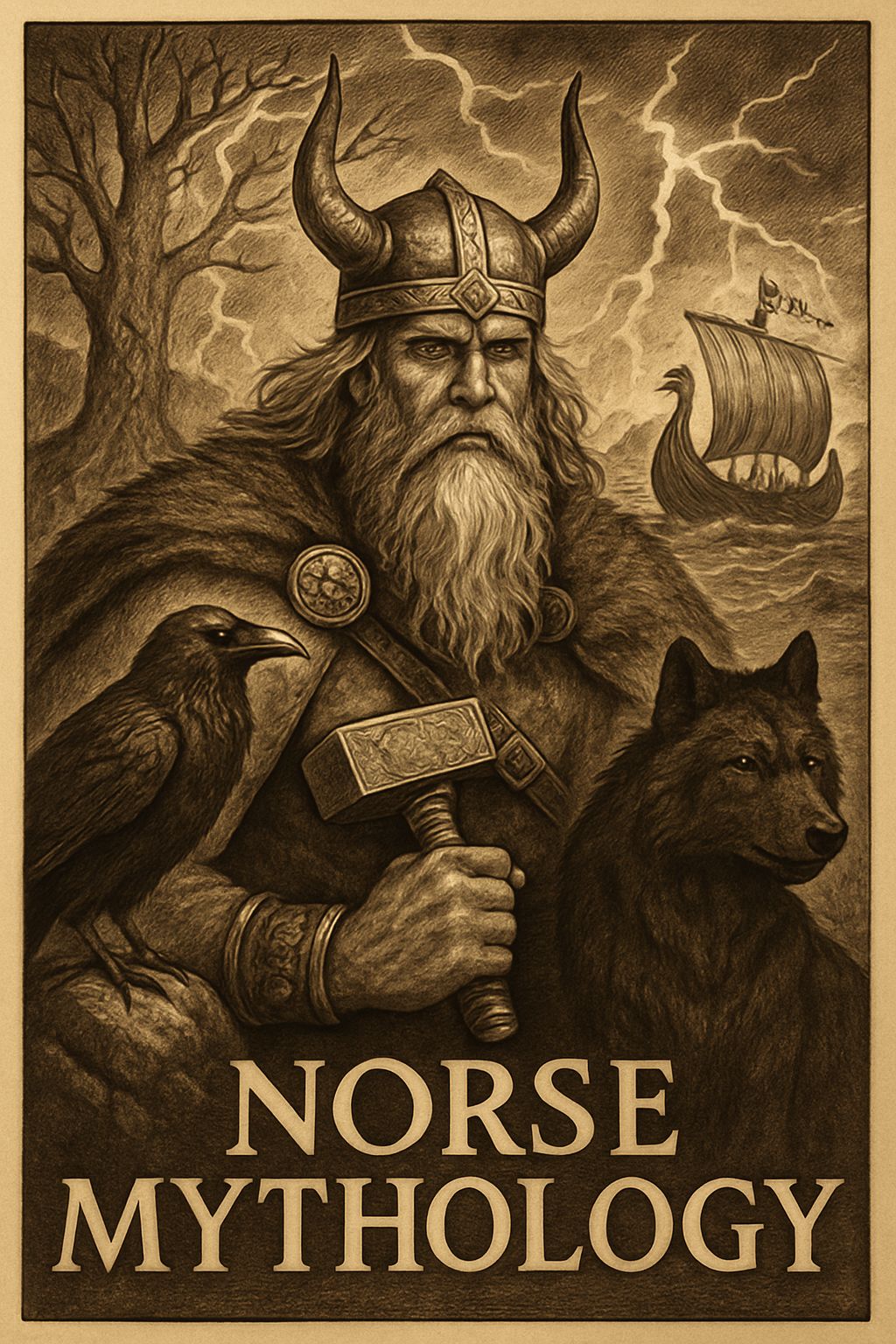
- Gold held divine status in Norse mythology — it was linked directly to the gods, the cosmos, and the afterlife, making it far more than a precious metal.
- Five core symbols dominate Norse gold design: Mjölnir, Yggdrasil, the Valknut, the ravens Huginn and Muninn, and the Vegvísir — each carrying layered mythological meaning.
- Viking Age art movements like Borre, Jelling, Ringerike, and Urnes created the visual grammar that still shapes Norse-inspired jewelry and design today.
- Archaeological finds — including Mjölnir amulets in pagan burials and silver Valkyrie figures — confirm that these weren’t just symbols; they were sacred objects tied to real belief systems.
- Norse Spirit crafts authentic Norse-inspired jewelry rooted in this exact heritage, bridging the ancient world and modern design with pieces that carry real mythological weight.
Norse mythology doesn’t just tell stories — it encodes an entire visual universe into every hammer, tree, and raven it depicts.
For thousands of years, the symbols and stories of the Norse world have shaped how people express identity, power, and belief through design. Whether you’re drawn to Viking-era artifacts or modern Norse-inspired gold jewelry, understanding where these designs come from transforms how you see them. Norse Spirit is one of the few modern makers deeply rooted in this tradition, creating pieces that honor the authentic mythology behind every motif.
Gold Was Sacred in Norse Mythology — Here’s Why
Gold wasn’t simply valuable to the Norse — it was cosmically significant. In the mythological framework of the Norse world, gold appeared at the heart of creation stories, divine conflicts, and the halls of the gods themselves. It wasn’t a neutral material; it carried weight, meaning, and consequence.
Gold as a Symbol of Divine Power Among the Norse Gods
The gods of Asgard were inseparable from gold. Odin’s hall, Valhöll, had a roof described as being made of shields, with rafters of spears — but gold featured throughout the divine realm as a marker of cosmic authority. The dwarves, master craftsmen of Norse myth, forged golden treasures of immense power: Gullinbursti, the golden boar of Freyr; Draupnir, Odin’s gold ring that multiplied every ninth night; and of course, Mjölnir itself — Thor’s hammer, created in the same mythological forge. Gold was the medium through which divine power was made physical.
How Gold Connected the Mortal World to Asgard
For the Norse, offering gold — through burial, sacrifice, or votive deposits in bogs and rivers — was a direct line of communication with the divine. Archaeological finds across Scandinavia show gold objects deliberately placed in the earth or water, not lost but given. Gold arm rings were used in oath-taking ceremonies, making promises literally bound to a sacred metal. This connection between gold, the gods, and human ritual is what makes Norse gold design so much richer than surface-level aesthetics.
The Core Norse Symbols That Drive Gold Design Today
The visual language of Norse mythology is built on a handful of symbols so potent they’ve survived over a millennium and still appear on jewelry, tattoos, architecture, and art worldwide. Each one carries a specific mythological origin, and understanding that origin is what separates meaningful design from mere decoration.
These aren’t arbitrary shapes. Every curve of Yggdrasil’s branches and every angle of Mjölnir’s head was culturally loaded with cosmological meaning for the people who wore and used them. To delve deeper into these symbolic designs, explore the beauty of Norse jewelry.
1. Mjölnir: Thor’s Hammer and Its Protective Meaning
Mjölnir is the most recognizable symbol in Norse design — and for good reason. Thor’s hammer was the ultimate protective talisman in Viking Age Scandinavia. Worn as a pendant, it guarded against chaos, evil, and misfortune. Archaeologically, hundreds of Mjölnir amulets have been recovered from burial sites across Norway, Sweden, Denmark, and Iceland, almost always made from silver or iron, worn close to the body. The design is asymmetrical — the handle deliberately short, the result of Loki’s interference during its forging by the dwarves Brokkr and Sindri — and that imperfection is itself part of the symbol’s identity.
2. Yggdrasil: The World Tree as a Design Blueprint
Yggdrasil is the immense ash tree at the center of the Norse cosmos, connecting nine worlds across its roots and branches. Its roots reached into Niflheim (the realm of ice and mist), Jötunheimr (land of giants), and Asgard itself. Eagles nested in its canopy, a dragon gnawed its roots, and a squirrel named Ratatoskr ran endlessly between them carrying insults. As a design element, Yggdrasil offers an almost infinite visual vocabulary — interlocking branches, layered roots, and the web-like structure of interconnected worlds. It’s a natural fit for intricate metalwork, and its symbolism of unity, life, and cosmic order makes it one of the most meaningful motifs a designer can draw from.
The tree also represents the self-sacrifice of Odin, who hung from Yggdrasil for nine days to gain the wisdom of the runes. That sacrifice embedded the runes — and the tree — with a sense of earned, hard-won knowledge that elevates it beyond simple nature imagery.
3. The Valknut: A Symbol of Odin and the Fallen Warriors
The Valknut — three interlocked triangles — is one of the most visually striking and symbolically complex signs in Norse iconography. Its name roughly translates to “knot of the slain,” and it appears consistently in contexts associated with Odin and death in battle. It has been found carved on memorial stones, on a bed chamber excavated from the Oseberg ship burial, and on objects associated with sacrificial ritual.
What makes the Valknut so compelling for design is its geometry. The interlocking triangles create a sense of infinite interconnection — life, death, and rebirth folding into each other. No clean entry point, no clear exit. It perfectly encodes the Norse belief that death in battle wasn’t an ending but a transition, specifically to Valhöll and a place among Odin’s chosen warriors.
The symbol has also been interpreted as representing Odin’s power to bind and unbind the minds of warriors in battle — inducing the berserkr state or stripping courage at will. That dual power of mental control and liberation gives the Valknut a psychological edge that few other symbols carry.
In modern Norse-inspired gold design, the Valknut appears frequently as a pendant centerpiece, often rendered in high relief to emphasize its three-dimensional geometry. When crafted in gold or sterling silver, the interlocking triangles create shadow and depth that flat designs simply can’t replicate.
Symbol Spotlight: The Valknut
Attribute Detail Norse Name Valknut (“Knot of the Slain”) Associated God Odin Key Archaeological Sites Oseberg ship burial, Gotland memorial stones Design Geometry Three interlocked triangles Core Symbolism Death in battle, transition, Odin’s power to bind/unbind Common Modern Use Pendant jewelry, tattoo design, Norse-inspired metalwork
4. Ravens Huginn and Muninn: Wisdom Woven Into Gold Art
Odin’s two ravens — Huginn (Thought) and Muninn (Memory) — flew across all nine worlds each day and returned to whisper what they had seen into Odin’s ears. They are his eyes across the cosmos, and their presence in Norse art signals intelligence, awareness, and the weight of accumulated knowledge. In design, paired ravens almost always reference this mythology directly, making them a powerful shorthand for wisdom and the seen world. Raven motifs in Viking Age metalwork often appear with outstretched wings, heads turned toward each other — a visual dialogue between thought and memory that translates beautifully into pendant and brooch design.
5. The Vegvísir: The Viking Compass of Guidance
The Vegvísir — often called the Viking compass — is an Icelandic magical stave, a symbol of navigation and protection against getting lost. It appears in the 17th-century Icelandic Huld Manuscript with the inscription: “If this sign is carried, one will never lose one’s way in storms or bad weather, even when the way is not known.” While its roots are in post-Viking Icelandic folk magic rather than the original Viking Age itself, its visual complexity — eight arms radiating from a central point, each ending in a distinct runic-style termination — has made it one of the most popular Norse-inspired design elements in contemporary gold jewelry and tattoo art.
Viking Age Art Styles That Shaped Norse Gold Designs
The symbols are only part of the story. The way those symbols were rendered — the visual style, the line quality, the use of animal forms and interlace — evolved through distinct artistic movements across the Viking Age. These movements weren’t random; they were regional, chronological, and deeply connected to cultural contact with other civilizations.
Understanding these art styles turns a Norse-inspired design from a symbol on a surface into something historically grounded and visually coherent. Each style has its own rules, its own energy, and its own design logic.
Borre and Jelling: The Gripping Beast Patterns
The Borre style, dating from roughly 850 to 950 CE, is one of the earliest distinctly Viking artistic movements. Its defining feature is the gripping beast — an interlocked animal figure that grips its own body or the bodies of neighboring creatures with paws and limbs. These beasts appear on everything from harness fittings to gold pendants, always in dense, interlocking compositions that leave almost no negative space. The result is a visual intensity that feels simultaneously chaotic and controlled — a perfect reflection of the Norse cosmological worldview where order and chaos are perpetually locked in tension.
The Jelling style, which overlapped with and eventually superseded Borre around 900 CE, introduced a more fluid, ribbon-like animal form. Named after the royal burial mounds at Jelling, Denmark, this style features sinuous, S-curved animal bodies with clearly defined heads — often with spiral hips and pronounced eyes. Where Borre feels dense and aggressive, Jelling feels dynamic and elegant. The transition between these two styles reflects a broader cultural shift in Viking Scandinavia — increased contact with Continental Europe and a growing sophistication in artistic expression.
Ringerike Style: Elegant Tendrils and Flowing Lines
Emerging around 980 to 1075 CE, the Ringerike style marks a significant turning point in Norse art. Named after a region in Norway where several key examples were found carved in stone, this style brought organic plant-based elements — spiraling tendrils, looping foliage, and elongated animal forms — into the Viking artistic vocabulary. The influence of English and Carolingian art is unmistakable here, absorbed through trade and raiding contact, then transformed into something distinctly Norse.
- Defining feature: Long, curling plant tendrils interweaving with animal figures
- Animal forms: Elongated, with thin limbs and graceful movement
- Key materials: Stone carvings, metalwork, and manuscript illumination
- Cultural influence: Strong borrowing from Anglo-Saxon and Carolingian artistic traditions
- Design feel: Flowing, organic, more open composition than Borre or Jelling
What makes Ringerike so valuable as a design reference is its balance. The compositions breathe — there’s genuine negative space between the tendrils and animal forms, which makes each element readable on its own while still contributing to the whole. For gold jewelry design, this translates into pieces where the eye can travel, rest, and discover.
The great lion-and-serpent compositions that define Ringerike’s most celebrated works — including the famous Vang stone and the Søberg weathervane — show just how theatrically Norse artists could compose a scene within the constraints of an ornamental frame. These weren’t just decorative patterns; they were narrative arrangements, telling stories through gesture and line.
Urnes Style: The Most Refined Viking Animal Art
The Urnes style, flourishing from approximately 1050 to 1150 CE, represents the pinnacle of Viking Age decorative art. Named after the carved wooden portal of the Urnes Stave Church in Norway — a UNESCO World Heritage site — this style strips Viking animal interlace down to its most essential and elegant form. The animals become almost abstract: long, sinuous bodies with fine, hair-like limbs that loop and intertwine in compositions of extraordinary complexity and grace. The biting interactions between creatures remain, but they’re rendered with a lightness and precision that earlier styles never achieved.
Urnes style is particularly significant for gold and silver jewelry design because its fine, curving lines translate directly into filigree work — thin wire twisted and shaped into intricate interlace patterns. Several archaeological finds of Viking Age jewelry show Urnes-influenced filigree that still looks strikingly modern. The style also influenced early Romanesque art across Northern Europe, meaning its visual legacy extends well beyond the Norse world and into the broader medieval artistic tradition.
The Gods Behind the Gold: Odin, Thor, and Freyja
The Norse pantheon wasn’t abstract theology — it was a cast of vivid, complex characters whose stories generated an entire visual culture. Each major deity came with specific symbols, animals, and objects that functioned as visual shorthand for their identity and power. When Viking Age craftsmen created gold and silver objects, they weren’t just making jewelry; they were encoding divine narratives into wearable form.
Three gods dominate Norse design inspiration above all others: Odin, the Allfather of wisdom and war; Thor, the hammer-wielding protector of humanity; and Freyja, goddess of love, fertility, and the most powerful practitioner of seiðr magic in all the nine worlds. Together, their symbols account for the majority of surviving Norse-era amulets, pendants, and decorative objects.
Understanding these three deities — their myths, their symbols, their relationships — is the single most powerful tool a designer can have when working with Norse material. Every authentic Norse-inspired piece tells a story rooted in one of their narratives, much like the privately minted fantasy coins that often draw inspiration from these rich mythologies.
Odin’s Symbols and Their Design Legacy
Odin is visually one of the richest gods in the Norse pantheon. His symbol set includes the Valknut, the ravens Huginn and Muninn, the wolves Geri and Freki, his spear Gungnir (forged by the dwarves known as the Sons of Ivaldi), and the runes themselves — won through nine days of self-sacrifice on Yggdrasil. The Gungnir, in particular, is an underused design element: a spear that never misses its mark, inscribed with runes, thrown over enemy armies as an act of consecration before battle. As a design motif, it combines the linear elegance of a weapon with the mystical weight of runic inscription. For more on Norse mythology, visit this comprehensive guide.
Odin’s one eye — sacrificed at the Well of Mimir in exchange for cosmic wisdom — is another powerful design element. Single-eye motifs in Norse-inspired art carry this specific mythological weight: the idea that true knowledge requires sacrifice. This makes Odin’s symbols uniquely suited for designs meant to convey depth, earned experience, and hidden power rather than brute strength.
Freyja’s Connection to Gold, Beauty, and Jewelry
Of all the Norse gods, Freyja has the most direct and explicit connection to gold jewelry. Her most prized possession was the Brísingamen — a spectacular golden necklace or torc forged by four dwarves of the Svartálfaheimr, which Freyja desired so intensely she spent four nights with each dwarf to obtain it. The Brísingamen became inseparable from her identity, a symbol of her power, beauty, and the sacred femininity she embodied.
Freyja was also associated with amber — called “Freyja’s tears” in Norse tradition, shed as she searched for her missing husband Óðr. Amber, with its warm golden color and organic origin, was one of the most prized materials in Viking Age jewelry, traded across vast distances from the Baltic coast. This connection between Freyja, amber, and gold creates a coherent design palette: warm, luminous, organic, and charged with emotional depth.
Beyond jewelry, Freyja’s symbols include the falcon-feather cloak (which enabled flight between worlds), cats (who pulled her chariot), and the boar Hildisvíni. She also received half of all warriors slain in battle — the other half going to Odin — making her a figure of both fierce power and profound tenderness. Designs invoking Freyja work best when they balance these qualities: strength and softness, gold and wildness, beauty and battle.
Archaeological Evidence That Confirms Norse Gold Design Origins
The mythology and art styles described above aren’t theoretical reconstructions. They’re confirmed by a robust archaeological record stretching across Scandinavia, the British Isles, Iceland, and even as far as Constantinople and North America. The physical objects that survive tell us — with remarkable clarity — exactly how the Norse used sacred symbols in material form.
Mjölnir Amulets Found in Pagan Burial Sites
More than 1,000 Mjölnir amulets have been recovered from Viking Age sites, making Thor’s hammer the single most archaeologically attested Norse religious symbol. They range from simple iron casts to elaborately decorated silver pieces with filigree detailing and runic inscriptions. A significant find from Købelev on the Danish island of Lolland produced a Mjölnir amulet with the runic inscription “Hmar x is” — “This is a hammer” — the only known amulet that explicitly identifies itself, providing direct confirmation of the symbol’s intended meaning and use as a protective talisman.
Silver Valkyrie Figures and What They Reveal
Small silver figurines interpreted as Valkyries — the divine choosers of the slain who escorted fallen warriors to Valhöll — have been recovered from multiple sites across Scandinavia and Viking-settled territories. A particularly well-preserved example found in Hårby, Denmark in 2012 depicts a Valkyrie with a long dress, braided hair, a shield, and a sword, rendered in exquisite detail in silver. These figurines confirm that Valkyries weren’t abstract concepts but beings the Norse visualized with specific, consistent physical characteristics — information that directly informs authentic design representation of these figures in modern Norse-inspired work.
What the Eddas and Sagas Tell Us About Sacred Gold Objects
The Prose Edda, compiled by Snorri Sturluson around 1220 CE, and the earlier Poetic Edda are the primary literary sources for Norse mythology — and both are filled with specific descriptions of gold objects and their divine significance. The Prose Edda describes Asgard itself as having halls roofed and furnished with gold, golden chess pieces that the gods played with in the beginning of time, and the golden cock Gullinkambi who crows to wake the gods for Ragnarök.
The sagas add further texture, describing the gold arm rings kept on temple altars — sacred oath rings that chieftains wore and swore upon before making binding agreements. These weren’t decorative objects; they were instruments of social and religious contract. The weight of gold in Norse culture was both literal and metaphorical, and the sagas treat it with corresponding seriousness.
Together, the Eddas and sagas provide a design brief unlike anything from any other mythological tradition — specific, consistent, and rich with the kind of narrative detail that transforms a symbol from decoration into meaning. For anyone creating Norse-inspired gold design, these texts aren’t just background reading; they are the primary source material, and every authentic design decision traces back to something recorded within them.
How Modern Designers Draw From These Ancient Norse Roots
The gap between a 10th-century Viking craftsman and a modern jewelry designer is smaller than it looks. Both are working with the same visual library — the same symbols, the same cosmological framework, the same cast of gods and creatures — just with different tools and different audiences. What separates great Norse-inspired design from generic Viking aesthetic is the depth of engagement with the source material.
Quick Reference: Norse Art Style Timeline for Designers
Art Style Approximate Period Key Visual Feature Best Used For Borre 850–950 CE Gripping beast interlace, dense composition Bold statement pieces, warrior aesthetic Jelling 900–975 CE Ribbon animals, S-curves, spiral hips Dynamic pendants, fluid line work Ringerike 980–1075 CE Flowing tendrils, open composition Elegant rings, breathable design layouts Urnes 1050–1150 CE Fine interlace, sinuous abstracted animals Filigree jewelry, refined gold work
Modern designers working in the Norse tradition fall into two broad camps: those who pursue strict archaeological accuracy and those who blend historical motifs with contemporary or fantasy Viking aesthetics. Neither approach is wrong — but they serve very different purposes and audiences. The key is knowing which tradition you’re drawing from and being intentional about it. For those interested in incorporating high-end precious metal collectibles into their designs, understanding the historical context can be particularly beneficial.
The most compelling contemporary Norse-inspired pieces tend to sit at the intersection of both approaches. They root their symbol choices in verified mythology — using the Mjölnir’s correct asymmetrical proportions, rendering the Valknut’s interlocking triangles with geometric precision — while allowing modern materials and manufacturing techniques to bring those symbols to life in new ways. The mythology provides the meaning; the craft provides the expression.
Blending Historical Accuracy With Fantasy Viking Aesthetics
Fantasy Viking aesthetics — popularized by films, games, and television — have introduced Norse symbolism to a massive global audience. While not always archaeologically precise, this visual tradition has created genuine hunger for authentic Norse design among people who started with the fantasy and want to go deeper. Designers who can bridge that gap — honoring the emotional resonance of the fantasy aesthetic while grounding it in real mythology and real art history — occupy a uniquely powerful creative position. The most effective approach is to use historically accurate symbols as the foundation, then allow the rendering style, material choice, and compositional framing to carry whatever contemporary energy the piece needs, similar to how custom gold jewelry is crafted for specific cultural ceremonies.
Using the Sagas as a Visual Vocabulary for Storytelling
The Norse sagas aren’t just literary texts — they’re design briefs. Every saga contains specific visual descriptions of weapons, jewelry, ships, and clothing that can be translated directly into material form. The Völsunga saga describes cursed gold with the same specificity that a gemologist might use. The Prose Edda gives Mjölnir an origin story so detailed — the shortened handle, the dwarven forge, the interference of Loki — that it practically dictates design parameters. When designers engage with the sagas as source material, their work gains a narrative density that purely visual research simply cannot provide.
The sagas also offer something rarer: emotional context. They tell you not just what objects looked like, but what they meant to the people who owned and used them. A gold arm ring in a saga isn’t just a piece of jewelry — it’s a record of oaths sworn, loyalties pledged, and honor maintained or lost. Designing with that context in mind changes everything about how a piece is conceived and executed.
- Völsunga saga: Rich descriptions of cursed gold, dragon hoards, and dynastic rings — ideal source material for statement pieces with dark narrative weight
- Prose Edda: Precise mythological origin stories for Mjölnir, Gungnir, Draupnir, and Brísingamen — each offering specific design parameters
- Poetic Edda: Cosmological imagery of Yggdrasil, the nine worlds, and Ragnarök — invaluable for large-scale compositional designs
- Heimskringla: Historical grounding for Norse kingship symbols, oath rings, and ceremonial objects used in real political contexts
- Laxdæla saga: Detailed descriptions of Norse dress, jewelry, and personal adornment that reflect actual Viking Age material culture
Treating the sagas as a living reference library — returning to them at each stage of the design process — is what separates Norse-inspired work with genuine depth from pieces that simply borrow a visual style. The mythology rewards close reading with an almost inexhaustible supply of specific, usable, meaningful design intelligence.
These Ancient Symbols Still Speak — And They’re Louder Than Ever
There’s a reason Norse mythology has not faded into academic obscurity like so many other ancient belief systems. Its symbols carry a psychological weight that speaks directly to universal human experiences — the search for wisdom, the reality of death, the need for protection, the desire to belong to something larger than yourself. The Valknut encodes mortality with geometric elegance. Yggdrasil maps the entire cosmos onto a single living organism. Mjölnir transforms the concept of protection into an object you can hold in your hand. These aren’t just old symbols — they are extraordinarily well-engineered vehicles for meaning, built by a culture that thought deeply about what symbols were for.
What makes Norse design endure is the same quality that made Viking Age craftsmen exceptional: the refusal to separate beauty from meaning. Every gripping beast in a Borre-style composition was doing symbolic work. Every Urnes-style interlace was telling a story about the interconnection of all living things. When modern designers engage with this tradition honestly — drawing from the Eddas, learning the art styles, understanding the gods — they tap into a creative inheritance of extraordinary richness. The symbols were never decorations. They were always conversations with something ancient, powerful, and still very much alive. For those interested in unique cultural expressions, exploring custom gold jewelry for specific cultural ceremonies can offer further insights into how ancient traditions continue to inspire modern artistry.
Frequently Asked Questions
These are the most common questions readers have about Norse mythology’s connection to gold design and its enduring visual legacy.
What is the significance of gold in Norse mythology?
Gold in Norse mythology was a direct expression of divine power. It appeared throughout Asgard, was forged by the master craftsman dwarves into objects of supernatural ability, and served as the primary medium for sacred oath-taking through gold arm rings kept on temple altars. It wasn’t simply wealth — it was a material that bridged the human and divine worlds.
Specific gold objects in Norse myth carry enormous narrative weight: Odin’s ring Draupnir multiplied itself every ninth night, generating abundance from a single divine object. Freyr’s golden boar Gullinbursti could run through air and water and illuminate the night. Freyja’s Brísingamen necklace was so desired she paid an extraordinary personal price to own it. Gold was where myth became material, much like the allure of custom gold jewelry in various cultural ceremonies today.
Which Norse symbols are most commonly used in gold jewelry design?
The five most commonly used Norse symbols in gold jewelry design are Mjölnir (Thor’s hammer), Yggdrasil (the World Tree), the Valknut (Odin’s knot of the slain), the paired ravens Huginn and Muninn, and the Vegvísir (the Viking compass). Each carries specific mythological meaning that makes them more than decorative — they function as wearable statements of identity, protection, and cosmological belief rooted in over a thousand years of Norse tradition.
What Viking art styles are most influential in modern Norse-inspired designs?
The four key Viking Age art styles that most directly influence modern Norse-inspired design are Borre (850–950 CE), known for dense gripping beast interlace; Jelling (900–975 CE), defined by fluid ribbon-like animal forms; Ringerike (980–1075 CE), which introduced organic flowing tendrils and open compositions; and Urnes (1050–1150 CE), the most refined of all Viking art movements, characterized by sinuous, almost abstract animal interlace that translates directly into filigree metalwork.
Of these four, Urnes and Ringerike tend to have the greatest influence on fine gold jewelry specifically, because their open compositions and fine line quality suit the demands of high-detail metalwork. Borre and Jelling are more commonly referenced in larger-scale pieces, tattoo design, and carved or cast work where bold visual density is an advantage rather than a challenge.
How did the Norse gods influence gold design and jewelry traditions?
Each major Norse deity generated a specific set of symbols that functioned as wearable identity markers for their devotees. Thor’s Mjölnir was worn for protection, Odin’s Valknut and ravens signaled connection to wisdom and the warrior path, and Freyja’s Brísingamen established gold jewelry itself as a divinely sanctioned form of personal power. The gods didn’t just inspire design — they legitimized it, embedding the act of wearing sacred symbols with genuine religious and cultural significance that persisted across the entire Viking Age.
What archaeological discoveries support Norse mythology’s connection to gold?
The archaeological record for Norse sacred metalwork is extensive and specific. Over 1,000 Mjölnir amulets have been recovered from Viking Age burial sites across Scandinavia and Norse-settled territories, with the Købelev amulet from Denmark providing direct runic confirmation of their protective purpose. Gold and silver hoards deposited in bogs and rivers across Norway, Sweden, and Denmark confirm the practice of offering precious metals to the divine, a ritual described in both the Eddas and the sagas.
The Oseberg ship burial, excavated in Norway in 1904, contained exceptional examples of Viking Age decorative art including carved wooden objects featuring Valknut imagery, providing direct material evidence linking this symbol to funerary and Odin-associated ritual contexts. The Hårby Valkyrie figurine found in Denmark in 2012 demonstrated the level of visual specificity with which the Norse conceived their divine figures — a precision that directly informs authentic design representation today.
The Jelling monuments in Denmark — including runic stones commissioned by Harald Bluetooth around 965 CE and the royal burial mounds that gave the Jelling art style its name — represent perhaps the most important single archaeological site for understanding the intersection of Norse mythology, royal power, and artistic expression. The larger Jelling stone depicts Christ alongside traditional Viking animal interlace, capturing the exact moment when Norse and Christian visual cultures collided and began to merge.
Gold has always been a symbol of wealth and power, captivating the imagination of people throughout history. From ancient civilizations to modern times, gold has played a crucial role in shaping economies and cultures. Today, many investors are turning to ethically sourced gold as a sustainable investment option, ensuring that their investments align with their values and contribute to a better world.
0 responses to “Unlocking Gold Mysteries: The Norse Mythology Design Inspirations & Origins”